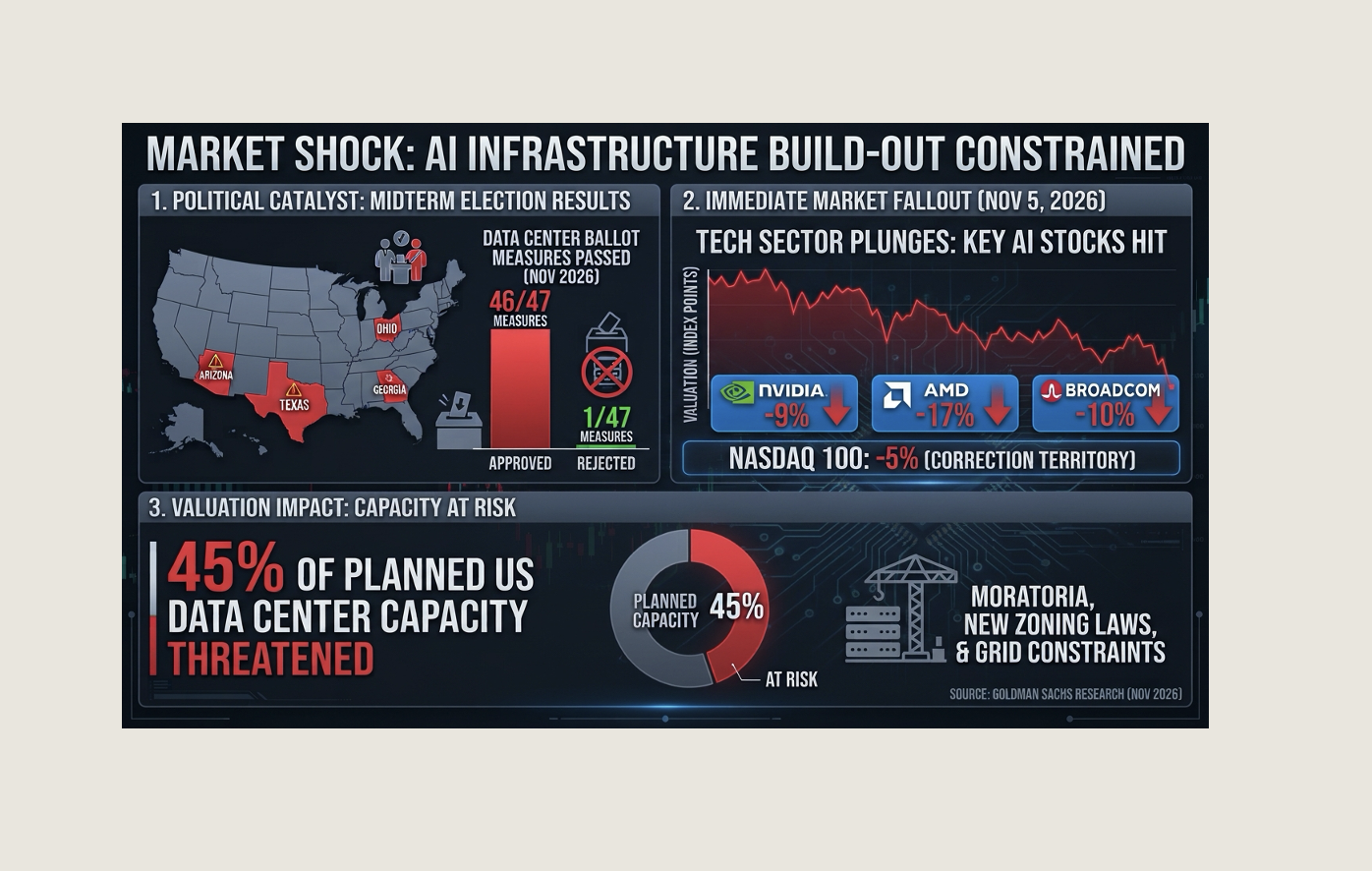
The rapid acceleration of localized anti-data center ballot measures and sweeping political victories has catalyzed a severe correction in artificial intelligence sector stock valuations, wiping out trillions in global technology market capitalization (Goldstein, 2026; Yorkville Ives, 2026). Following the 2026 U.S. midterm elections, financial markets are aggressively pricing in an increasingly restricted, heavily regulated, and materially slower infrastructure buildout (Goldman Sachs, 2026; Haranas, 2026).
The Election Catalyst and Market Fallout
On Thursday, November 5, 2026, technology stocks suffered their most aggressive single-day contraction since April 2025, driven by fears that the structural expansion powering the artificial intelligence sector had reached an immediate bottleneck (Fitch & Sottek, 2026).
Chipmaker Liquidation: Semiconductor and hardware companies experienced steep, immediate sell-offs. Nvidia dropped over 9%, erasing roughly $400 billion in market value in a single session, while Advanced Micro Devices (AMD) plunged 14% to 17%, and Broadcom fell about 10% (Goldstein, 2026).
Index Corrections: The technology-heavy Nasdaq Composite dropped between 5.2% and 5.5%, erasing its immediate post-election gains and pushing the index into technical correction territory, while the Philadelphia SE Semiconductor Index plummeted over 10% (Fitch & Sottek, 2026).
Infrastructure Vibrations: High-expenditure neocloud companies and site-prep operators faced sharp downward pressures. Capital expenditure anxieties saw CoreWeave drop 11% to 12% as credit default spreads widened to record highs (Goldstein, 2026).
Why the Local Backlash Scaled Nationally
Public concern regarding severe local utility price hikes, substantial water consumption, and overtaxed electrical grids shifted from hyperlocal tension into a coordinated regulatory barrier during the midterms (Ballotpedia, 2026; Wilder, 2026). Across the United States, voters actively favored tightening regulatory limits in 46 out of 47 decided data center ballot measures tracked by Ballotpedia (2026).
In Ohio—a major infrastructure nexus—voters approved 21 ballot measures restricting developments, including a local charter amendment in Piqua banning large data centers over 25 megawatts, which directly threatened Meta's planned $1 billion development (Semafor, 2026; Wilder, 2026). Meanwhile, newly elected Democratic governors in key hub states won campaigns on promises to implement immediate moratoriums. In Texas, which commands roughly a quarter of all planned U.S. data center capacity, Governor-elect Gina Hinojosa pledged an immediate statewide permit suspension pending strict residential and grid guidelines (Mishra, 2026).
Structural Realignments for AI Valuation
A note by Goldman Sachs (2026) highlighted that newly elected state leaders willing to impose construction pauses or trim tax incentives represent jurisdictions holding 45% of total planned U.S. data center capacity (Haranas, 2026). Consequently, market research firms like Yorkville Ives (2026) estimate that 10% to 20% of planned U.S. artificial intelligence facilities will be entirely removed from near-term roadmaps or face prolonged regulatory paths.
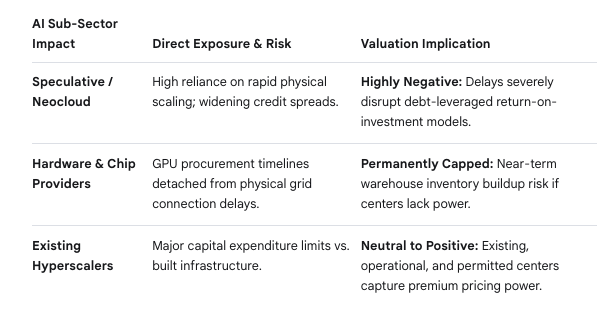
This immediate supply bottleneck has forced a bifurcated valuation model across the technology ecosystem:
Firms are moving quickly to adapt to this political climate. Speaking at a Wall Street Journal conference, Meta President Dina Powell McCormick acknowledged that building domestic infrastructure will be significantly harder, causing hyperscalers to evaluate hedging strategies by building capacity outside the United States (Fitch & Sottek, 2026). While macro-level computing demand remains exceptionally robust, the era of uninhibited domestic infrastructure expansion has met structural boundaries.
References
Ballotpedia. (2026, November 4). Data center-related ballot measures, 2026. ballotpedia.org
Fitch, A., & Sottek, T. (2026, November 5). AI investment bust seen less likely with data center backlash. Bloomberg News. bloomberg.com
Goldman Sachs. (2026, November 4). Macroeconomics of the digital grid: Midterm implications for hyperscaler CapEx [Equity Research Note].
Goldstein, S. (2026, November 5). Data center stocks just plunged. Here is why. Yahoo Finance. yahoo.com
Haranas, M. (2026, November 5). AI data center opponents win big in midterms, impacting 45% of planned US capacity: Goldman Sachs. Tech Insider. tech-insider.org
Mishra, S. (2026, November 5). How the Texas election could freeze the data center boom. CNN Business. cnn.com
Semafor. (2026, November 4). Data center ballot measures hit home for tech giants. semafor.com
Wilder, Chris. (2026, November 4). Across Southwest Ohio, voters pushed back against data centers and politicians who support them. WYSO. wyso.org
Yorkville Ives. (2026, November 5). Re-evaluating semiconductor demand under infrastructure constraints [Market Research Report].