Two labyrinths, two worlds of meaning
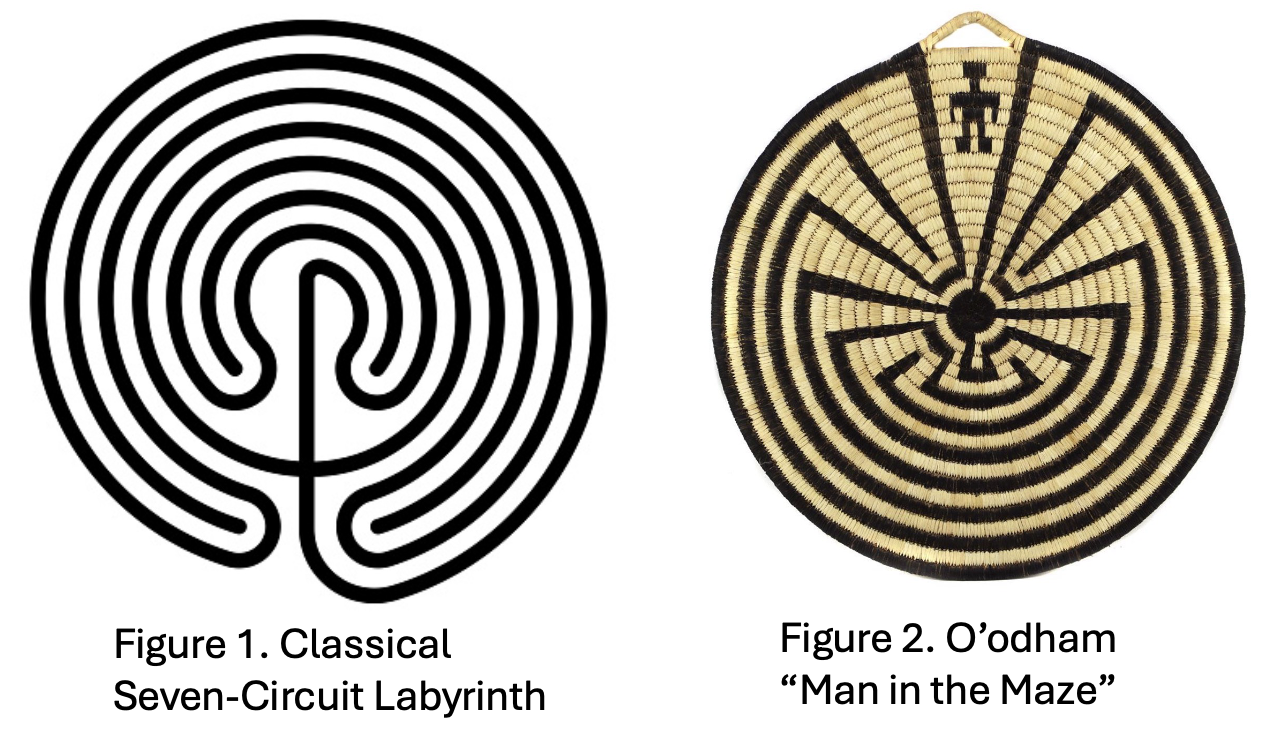
Across continents and millennia, human beings have drawn winding paths that lead inward. The two labyrinths shown above—the Classical seven‑circuit pattern (Figure 1) and the O’odham “Man in the Maze” (Figure 2)—share the essential idea of a single, unbroken journey toward a center. Yet they arise from entirely different cultural landscapes, and the contrast between them reveals how societies encode their deepest understandings of life, order, and purpose into geometry.
The Classical labyrinth, familiar from Bronze Age Crete and later from Roman mosaics and medieval cathedral floors, is a study in symmetry and inevitability. Its seven circuits unfold in a rhythmic sequence of turns that feel almost musical. The walker enters, follows the alternating pattern, and arrives at the center without ever confronting a choice. The design suggests a universe governed by order—cosmic, architectural, and spiritual. In medieval Europe, this pattern became a metaphor for pilgrimage: a symbolic journey toward salvation, undertaken not by choosing among paths but by submitting to a divinely structured progression.
The Man in the Maze, by contrast, emerges from the cultural and spiritual traditions of the Tohono O’odham and Akimel O’odham peoples of what is now the State of Arizona in the Southwest of the United States of America. Its geometry is more angular, more woven, shaped by the basketry traditions in which it is most often rendered. At the entrance stands a human figure—sometimes interpreted as I’itoi, the Elder Brother—poised to begin the journey. The path still inevitably leads to the center, but its turns are understood as the choices, challenges, and lessons encountered over a lifetime. Where the Classical labyrinth emphasizes cosmic order, the O’odham design foregrounds personal agency, moral development, and the search for balance.
The contrast is striking. One pattern is anonymous and architectural; the other is inhabited and narrative. One encodes a worldview in which the pilgrim moves through a predetermined structure; the other depicts a life shaped by decisions, setbacks, and growth. Yet both designs converge on a shared insight: that meaning lies not only in reaching the center but in the act of moving toward it.
Placed side by side, the two labyrinths illustrate how different cultures use similar forms to express profoundly different ideas. The Classical labyrinth is a map of the cosmos; the Man in the Maze is a map of the self. Together, they show that the human impulse to draw a path inward is universal, even as the stories we tell along that path remain beautifully diverse.
Note: Prepared by H. Pike Oliver with research assistance from artificial intelligence (Microsoft Copilot).
Sources:
Ashmolean Museum. “Myths of the Labyrinth.” Ashmolean Museum, University of Oxford. Accessed May 21, 2026. https://www.ashmolean.org/article/myths-of-the-labyrinth.
Blog My Maze. “The Native American Labyrinth: The Man in the Maze.” Blog My Maze (WordPress), October 25, 2009. Accessed May 21, 2026. https://blogmymaze.wordpress.com/2009/10/25/the-native-american-labyrinth-the-man-in-the-maze/.