Statements by POTUS47 at the World Economic Forum
This is an excerpt from POTUS 47's remarks at the World Economic Forum on January 21, 2026.
We've cut federal spending by $100 billion and slashed the federal budget deficit by 27% in the single year. It's going to go down quite a bit more from that, driving inflation way down from the record highs of the Biden administration. Every month they went up and up and up. I promised to cut 10 old regulations for every single new regulation, but instead I've cut – actually, till this point – 129 regulations for every one new regulation approved. So, every time they come in with a new regulation, we do at least 10. But so far, it's averaging out to 129, if you can believe it.
Assessment of the statements
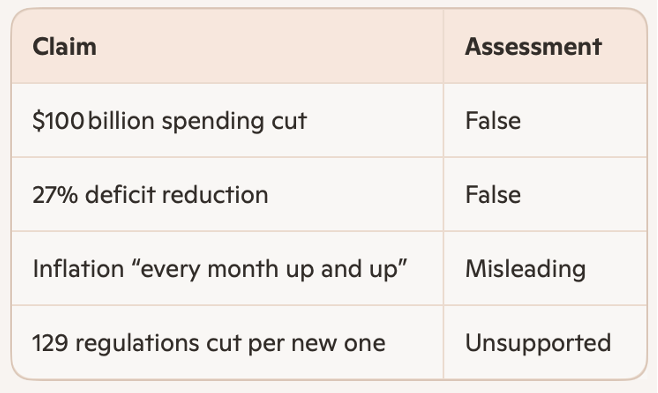
Microsoft's Copilot AI bot assessed the accuracy of the statements in the excerpt. Here is what it found.
Claim 1: “We’ve cut federal spending by $100 billion.”
No federal data supports a $100 billion reduction in spending. Independent reviews of the administration’s claimed savings from contract cancellations found far smaller amounts—closer to $1–2 billion, not $100 billion. Even if all claimed savings were real, they would not reduce the deficit unless Congress rescinded appropriated funds.
Assessment: False or unsupported.
Note 1: Eric Katz, “Trump’s Claim of $100 Billion in Savings from Contract Cancellations Doesn’t Add Up,” Government Executive, January 10, 2025, https://www.govexec.com/management/2025/01/trumps-claim-100-billion-savings-contract-cancellations-doesnt-add/394123/
Claim 2: “We slashed the federal budget deficit by 27% in a single year.”
Congressional Budget Office data shows the deficit fell by roughly 2 percent, not 27 percent. A 27 percent reduction would require a drop of nearly half a trillion dollars, which did not occur.
Assessment: False.
Note 2: Congressional Budget Office, “Monthly Budget Review: October 2025,” November 7, 2025, https://www.cbo.gov/publication/60655
Claim 3: “Driving inflation way down from the record highs of the Biden administration. Every month they went up and up and up.”
Inflation did reach a 40‑year high in mid‑2022, but it did not rise “every month.” It fluctuated and then declined steadily through 2023 and 2024, reaching about 3 percent by mid‑2024. The statement exaggerates both the pattern and the timing.
Assessment: Partly grounded in fact but significantly misleading.
Note 3: Bureau of Labor Statistics, “Consumer Price Index Summary,” various releases, https://www.bls.gov/cpi/
Claim 4: “I’ve cut 129 regulations for every one new regulation approved.”
There is no independent evidence supporting a 129‑to‑1 ratio. The administration did issue an order requiring ten regulations to be repealed for each new one, but no verifiable data confirms anything close to the claimed figure. The only historically documented ratio from Trump’s first term was about 5.5 to 1.
Assessment: Unsupported and not credible.
Note 4: U.S. Office of Information and Regulatory Affairs, “Regulatory Reform Results for Fiscal Year 2019,” https://www.reginfo.gov/public/do/eAgendaHistoricalReport