Peter Calthorpe's grid and the California Forever plan
The foundational principles of New Urbanism owe much to Peter Calthorpe, a highly regarded architect and planner out of San Francisco. Along with co-founding the Congress for the New Urbanism—where he initially served as board president—Calthorpe significantly influenced modern planning by formalizing Transit-Oriented Development (TOD) principles.
Calthorpe laid out an urban planning land-use and circulation framework in his influential 1993 volume, The Next American Metropolis.² By directly linking public transit infrastructure to neighborhood zoning, his work offered a practical alternative to sprawling, low-density suburbs, favoring pedestrian-friendly, mixed-use neighborhoods.
The 2002 urban grid diagram, formally introduced as part of Calthorpe's "Urban Network" concept, stems from his critique of the automobile-dependent, post-World War II suburban grid of arterial roads and freeways. Seeking an alternative blueprint to typical suburban sprawl, Calthorpe proposed a layout that integrates multi-modal transportation with New Urbanist principles.¹
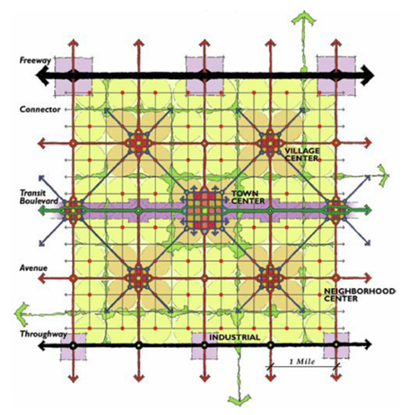
This layout highlights a flexible, adapted grid structure. Built around a network of Transit Boulevards, Avenues, and smaller local streets, the framework intentionally routes traffic to cultivate pedestrian-friendly, human-scale neighborhoods. Rather than routing vehicles completely around commercial hubs, the grid channels dense Transit-Oriented Developments (TODs) and mixed-use town centers into major transit intersections. The result is an intensely integrated landscape. It balances the needs of walkers, cyclists, and transit riders simultaneously.¹
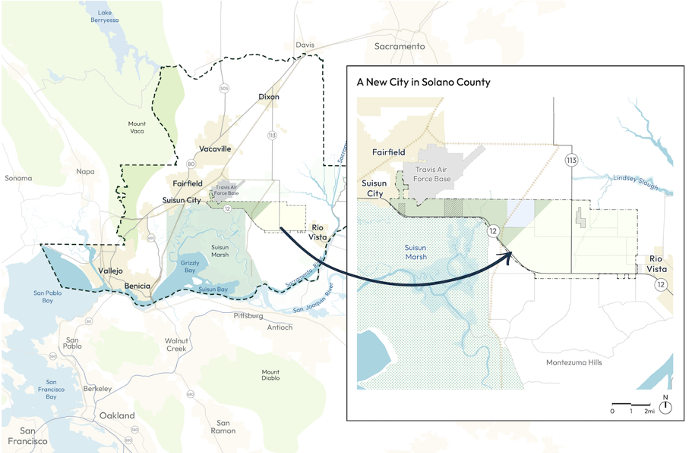
California Forever's urban designers did not apply Calthorpe's urban network diagram verbatim. The land use and circulation plan is for a proposed city with an ultimate population of 400,000 in Solano County, southwest of Sacramento and northeast of San Francisco.³˒ ⁵
California Forever's urban designers have prepared a land use and circulation plan for a proposed city with an ultimate population of 400,000 in Solano County, southwest of Sacramento and northeast of San Francisco. While they did not apply the urban network diagram verbatim, the land-use and circulation plan incorporates elements of the Calthorpe framework. Notably, the planning team credits Calthorpe's foundational Transit-Oriented Development (TOD) principles.²˒ ³˒ ⁵
Make it stand out
Whatever it is, the way you tell your story online can make all the difference.
The design process for California Forever began by examining much older grids, including the New York Commissioner’s grid-like plan for Manhattan in 1811 and O'Farrell and Eddy's 1849 plan for San Francisco. Plans for other North American cities, such as Chicago, Savannah, and Charleston, also inspired the plan. The work of other New Urbanism founders, including Andres Duany and Steve Mouzon, also influenced the California Forever plan.3, 5
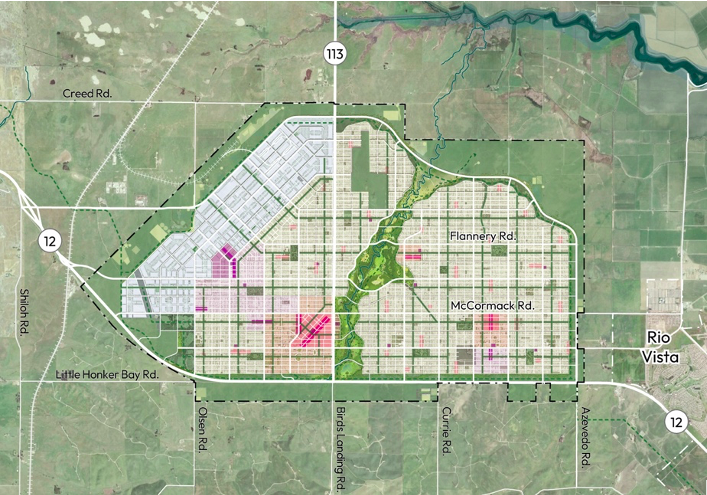
The land use and circulation framework for California Forever (shown on the following page) reflects several similarities and departures from Calthorpe's grid.³
Make it stand out
Whatever it is, the way you tell your story online can make all the difference.
Conceptual commonalities
The 2002 Urban Network diagram relies on a strict, alternating grid hierarchy of high-capacity arterials versus slower neighborhood streets. The California Forever design incorporates what some urbanists describe as a “tartan grid." This strategy prevents commercial zones from bleeding directly onto major, fast-moving roadways. It weaves together multimodal movement streets with separate transit lanes and highly filtered, pedestrian-safe neighborhood roads.²˒ ⁴
Like the one-mile-interval Town and Village Centers in Calthorpe's schematic, California Forever uses a polycentric framework of distinct commercial districts, localized neighborhood centers, and maker spaces to ensure that every home is within a short walk of daily services.²˒ ³
Departures from Calthorpe's grid
Calthorpe's 2002 grid is a perfectly flat, geometric abstraction. California Forever's land-use maps are irregularly shaped to fit Solano County's natural topography, wind-farm placements, and flight-safety buffer zones around Travis Air Force Base. The plan also reflects a hybrid grid somewhat like Barcelona's Superilles (superblocks) first delineated in the 19th-century Eixample urban expansion plan.²˒ ³˒⁵
Conclusion
Although the California Forever plan is not a direct implementation of Peter Calthorpe's 2002 Urban Network model, it reflects many of the same planning principles. The plan's emphasis on transit-oriented development, polycentric neighborhood centers, hierarchical street systems, walkability, and mixed-use urbanism demonstrates the ongoing influence of Calthorpe's planning philosophy on contemporary large-scale community design.³
This is an evolution of the design lineage, not a direct copy. While the project's design consultants (SITELAB and CMG) describe the master plan via generalized New Urbanist and multi-modal street typologies, the property owner and developer of California Forever explicitly credits Peter Calthorpe's early-1990s Transit-Oriented Development frameworks as a core structural inspiration for the city's scale and layout.²˒ ³˒ ⁴˒ ⁵
Notes and Sources
1. Urban Network Diagram Source
Peter Calthorpe, Urban Network regional planning model (c. 2002). Diagram illustrating the hierarchy of Transit Boulevards, Connectors, Avenues, and Throughways. Reproduced from the Tyler Topics City Hall Commons archive of Calthorpe planning materials.
Amanda D. Wettergren, “Peter Calthorpe's Urban Network Concept,” City Hall Commons, Tyler Topics, accessed September 28, 2026, https://tylertopics.com/cityhallcommons/topiclist/d373.calthorpe.html.
2. Calthorpe's Core Concepts and Network Origins
Peter Calthorpe pioneered the modern concept of Transit-Oriented Development (TOD) in The Next American Metropolis: Ecology, Community, and the American Dream (1993). His later Urban Network framework expanded these ideas into a regional grid system intended to accommodate growth while preserving walkable centers.
Peter Calthorpe, The Next American Metropolis: Ecology, Community, and the American Dream (New York: Princeton Architectural Press, 1993), https://archive.org/details/nextamericanmetr0000calt
Amanda D. Wettergren, “Peter Calthorpe's Urban Network Concept,” City Hall Commons, Tyler Topics, accessed September 28, 2026, https://tylertopics.com/cityhallcommons/topiclist/d373.calthorpe.html.
3. California Forever's Urbanist Design Framework
California Forever's planning team has explicitly cited New Urbanist principles, walkable neighborhoods, transit orientation, and traditional town-building precedents as major influences on the Suisun Expansion proposal.
“The Urbanist Case for the Suisun Expansion,” California Forever, January 17, 2026, https://californiaforever.com/the-urbanist-case-for-the-suisun-expansion/.
California Forever, “Maps and Visualizations,” California Forever Press Kit, accessed September 28, 2026, Maps and Visualizations.
4. The Tartan Grid Concept
Urban planning commentators have described California Forever's circulation system as a "tartan grid" that combines transit-priority corridors, local neighborhood streets, bicycle networks, and pedestrian-oriented public spaces.
Robert Steuteville, “Proposed: A New California City,” Congress for the New Urbanism, December 4, 2025, https://www.cnu.org/publicsquare/2025/12/04/proposed-urbanism-forever;
“The Urbanist Case for the Suisun Expansion,” California Forever, January 17, 2026, https://californiaforever.com/the-urbanist-case-for-the-suisun-expansion/.
5. California Forever Master Plan and Physical Layout
Descriptions of neighborhood centers, land-use organization, walkability metrics, geographical constraints, and overall master-plan structure are drawn from California Forever planning documents, SITELAB Urban Studio materials, and independent reporting on the project.
“Suisun Expansion Plan,” SITELAB Urban Studio, accessed September 28, 2026, https://www.sitelaburbanstudio.com/suisun-expansion-plan;
Vitaliy Moskalenko, “California Forever Files Plan to Expand Suisun City for Massive New Community East of Town,” Onsite Observer, October 14, 2025, https://www.onsiteobserver.com/california-forever-files-plan-to-expand-suisun-city-for-massive-new-community-east-of-town/.