Combining proportional representation and ranked choice voting
Proportional representation (PR) works well with ranked‑choice voting (RCV). This system is typically called Proportional Ranked‑Choice Voting (PRCV) or Single Transferable Vote (STV). PR‑RCV is the best‑fit model for implementing proportional representation in the United States because it preserves candidate‑based voting while eliminating winner‑take‑all distortions of voter preferences.
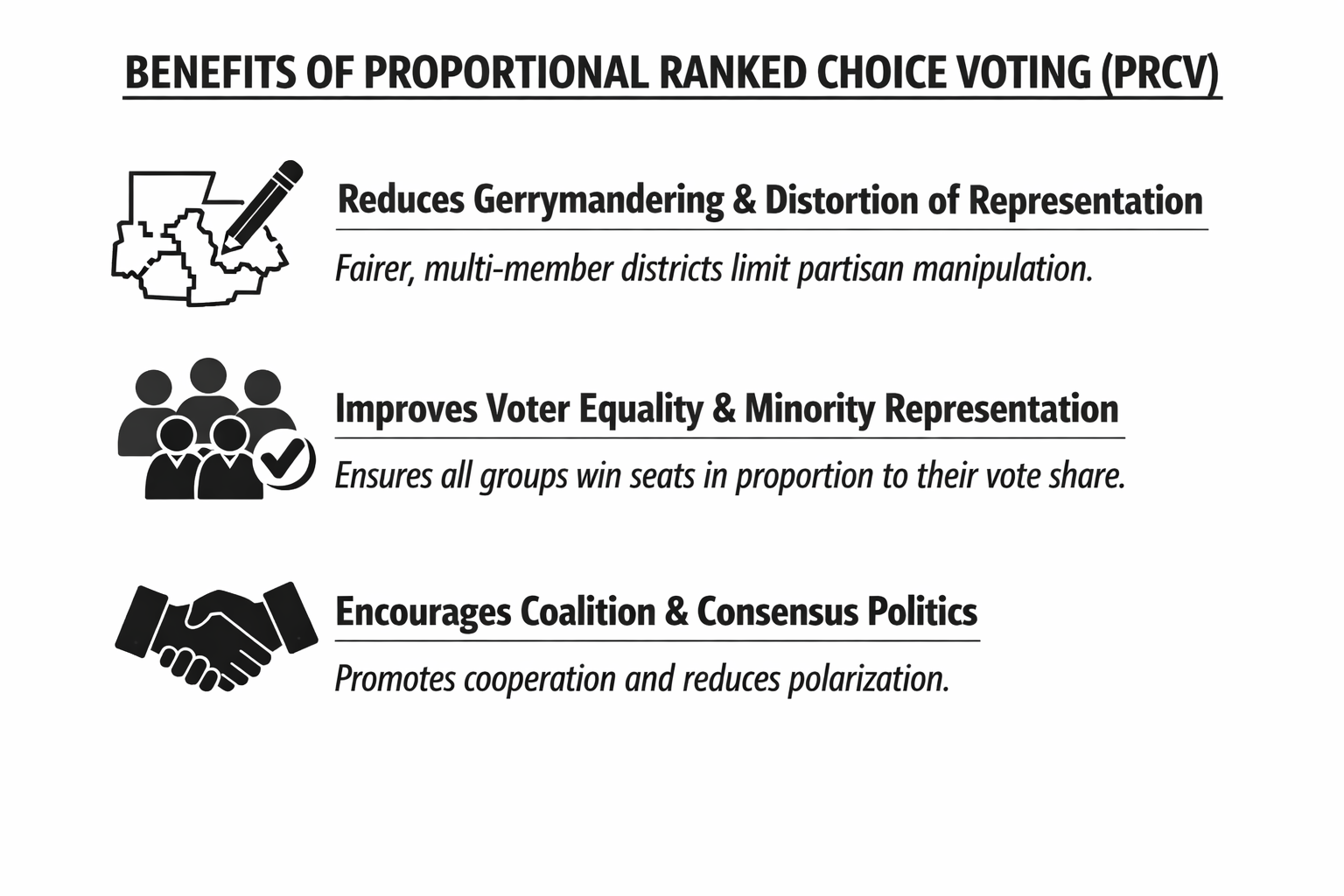
<— The key benefits
How proportional representation works with ranked‑choice voting
The mechanics are straightforward:
Use multi‑winner districts. PR requires electing more than one representative per district. E.g., instead of 10 single‑member districts, create one 10‑member district.)
Voters rank candidates. Voters mark candidates 1, 2, 3, etc., just as in single‑winner RCV. This ranking allows votes to be transferred rather than wasted.
A vote quota determines how many votes a candidate needs to win. Once a candidate reaches the quota, they are elected.
Surplus votes transfer. If a candidate has more votes than needed, the surplus transfers to voters’ next choices.
Eliminations and transfers continue. The lowest‑performing candidates are eliminated, and their votes transfer until all seats are filled.
This ensures that each elected representative corresponds to a distinct group of voters, and that groups representing, say, 20% of the electorate can win roughly 20% of the seats.
Why PR + RCV is a strong combination
Minimizes wasted votes. RCV ensures that if a voter’s top choice cannot win, their vote still helps elect someone they support.
Enables proportional outcomes. Because votes transfer, smaller parties or minority groups can win seats in proportion to their support.
Preserves candidate‑based voting. Unlike party‑list PR, voters choose people, not just parties — a feature many U.S. voters prefer.
Reduces gerrymandering. Multi‑winner districts make it extremely difficult to engineer partisan outcomes.
Already tested in the United States. Local jurisdictions have used RCV for decades, and the method has been validated in real elections. See sources listed below.
Sources
FairVote. Ranked Choice Voting. Takoma Park, MD: FairVote. Accessed May 11, 2026.
Ranked Choice Voting Resource Center. Ranked Choice Voting Resource Center (implementation resources, jurisdictional case studies, and technical validation). Accessed May 11, 2026.
National Conference of State Legislatures. Ranked‑Choice Voting. Denver, CO: National Conference of State Legislatures. Accessed May 11, 2026.
https://www.ncsl.org/elections-and-campaigns/ranked-choice-voting